The TREKOLOGY ALUFT Pro is the best camping pillow for most UK campers: it combines adjustable air support with a quiet foam-padded washable cover, without taking up the space of a filled pillow. The Eono is the lightweight budget choice, Sea to Summit’s Aeros Premium is better for frequent lightweight trips, and the Therm-a-Rest Compressible Cinch is the comfort pick when the car carries your kit.
In This Article
- Best Camping Pillows UK: Our Direct Answer
- The Best Camping Pillows at a Glance
- Our Six Camping Pillow Recommendations
- How to Choose a Camping Pillow
- Inflatable vs Compressible Camping Pillows
- Match Your Pillow to Your Sleeping Setup
- Care, Packing and Common Mistakes
- Which Camping Pillow Should You Buy?
- Frequently Asked Questions
Best Camping Pillows UK: Our Direct Answer
Buy the TREKOLOGY ALUFT Pro if you want one camping pillow that can move between a backpack, family tent and travel bag. Its foam-padded cover, adjustable air chamber and sleeping-mat strap solve the main complaints about basic inflatables while keeping the packed size practical for mixed camping and travel use.
There is no universal winner for every sleep position. Side sleepers should look first at the larger ALUFT Ultra, backpackers prioritising low weight can use the 100g Eono, and car campers who hate the feel of air should choose the Therm-a-Rest. The Trespass is deliberately basic: it suits occasional trips and spare kits where simple packability matters more than a padded surface.
The Best Camping Pillows at a Glance
| Pillow | Best for | Key specification | Type | Main compromise |
|---|---|---|---|---|
| TREKOLOGY ALUFT Pro | Best overall | About 179g; foam-padded washable cover | foam-padded inflatable with a washable cover and mat strap | Heavier than a bare inflatable |
| Eono Ultralight Inflatable Pillow | Best budget inflatable | 100g; packs to about 13 x 8cm | 100g compact air pillow for lightweight backpacking | Basic surface feel |
| Sea to Summit Aeros Premium Regular | Best premium lightweight pillow | About 99g; PillowLock compatible | premium contoured inflatable with PillowLock compatibility | Works best with compatible mats |
| Therm-a-Rest Compressible Cinch Regular | Best compressible pillow | 46 x 33cm; adjustable foam loft | soft foam-filled choice for car camping and van trips | Bulky when packed |
| TREKOLOGY ALUFT Ultra | Best for side sleepers | 265g; 60 x 38 x 12cm inflated | large 60 x 38 x 12cm inflatable with removable cover | Larger and 265g |
| Trespass Snoozefest | Best for occasional use | Packaway inflatable; adjustable firmness | basic packaway inflatable for festivals and spare kits | Minimal cushioning |
Pillow height, packed volume, surface feel and whether it can stay attached to your mat matter more than short-term retail offers. Those differences determine whether a pillow works after midnight, not the number of superlatives in its listing.
Our Six Camping Pillow Recommendations
1. TREKOLOGY ALUFT Pro — Best overall

Weight: about 179g Type: Foam-padded inflatable with a washable cover and mat strap
The ALUFT Pro is the strongest all-round choice because it avoids the two usual extremes. It packs much smaller than a filled pillow, yet its removable foam-padded cover gives your face a softer surface than a bare air bladder. The listing states an inflated size of roughly 46 x 29cm, a packed size near 13 x 8cm and a weight around 179g. That balance suits weekend camping, backpacking and travel without pretending to be the lightest option.
- Buy it if: you want one adaptable pillow for tent, car and travel use.
- Skip it if: every gram matters or you want a fully filled, home-style feel.
- Main compromise: the foam cover adds weight and bulk compared with a basic inflatable.
2. Eono Ultralight Inflatable Pillow — Best budget inflatable

Weight: 100g Type: 100g compact air pillow for lightweight backpacking
Eono is the sensible entry point for occasional campers and anyone building a sleep kit on a tight budget. Its listing gives a weight of 100g and a packed size near 13 x 8cm, with a quick-deflate valve and adjustable firmness. Those specifications make it easy to carry as part of a lightweight sleep kit. The curved shape should provide more predictable support than a rolled fleece, while taking almost no meaningful space in a rucksack.
- Buy it if: low weight and packed size matter more than a plush surface.
- Skip it if: you dislike the feel or rustle of an inflatable under your ear.
- Main compromise: there is no padded removable cover, so comfort is more basic.
3. Sea to Summit Aeros Premium Regular — Best premium lightweight pillow
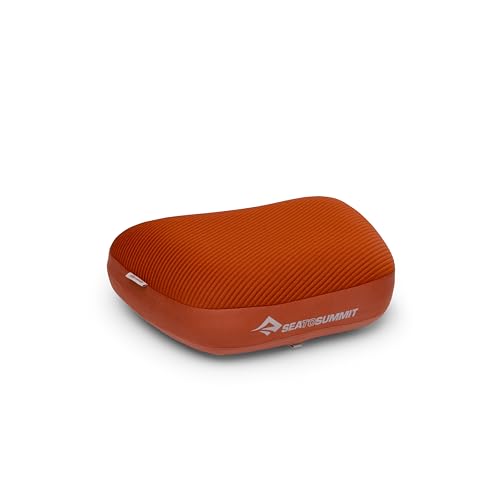
Weight: about 99g Type: Premium contoured inflatable with pillowlock compatibility
The Aeros Premium is for frequent backpackers who want a better-finished inflatable. Its current listing combines a contoured shape, brushed stretch-knit face fabric, a small foam layer and Sea to Summit’s PillowLock system for compatible mats. That makes it more refined than basic air pillows, particularly for restless sleepers whose pillow normally escapes towards the tent wall.
- Buy it if: you camp often, carry your kit and already value low weight and small volume.
- Skip it if: you use a different mat and will not benefit from the attachment system.
- Main compromise: its refined materials and attachment system may be unnecessary for one or two trips a year.
4. Therm-a-Rest Compressible Cinch Regular — Best compressible pillow

Size: 46 x 33cm Type: Soft foam-filled choice for car camping and van trips
Choose the Therm-a-Rest if you dislike sleeping on air. The Regular uses upcycled urethane foam beneath a stretch-knit cover, while an integrated cinch cord adjusts loft and firmness. It compresses into itself for transport, but this remains a comfort-first pillow rather than an ultralight one. Give it time to expand after unpacking; the manufacturer recommends leaving a newly received pillow open for 24 hours to restore loft.
- Buy it if: you camp from a car, campervan or roomy duffel and want a softer feel.
- Skip it if: you need the smallest possible backpacking bundle.
- Main compromise: it occupies far more pack space than an inflatable.
5. TREKOLOGY ALUFT Ultra — Best for side sleepers

Weight: 265g Type: Large 60 x 38 x 12cm inflatable with removable cover
The ALUFT Ultra is the size-led choice. Its stated 60 x 38 x 12cm inflated dimensions give broad-shouldered side sleepers more height and surface area than tiny trekking pillows, while the removable cover and detachable mat strap address cleaning and sliding. It weighs about 265g and packs to roughly the size of a water bottle, so it is portable but not the model for a minimalist fastpacking list.
- Buy it if: a small pillow leaves your neck dropping towards the mat.
- Skip it if: you sleep on your front or use a very thin foam mat.
- Main compromise: its larger dimensions and 265g weight cost more bag space.
6. Trespass Snoozefest — Best for occasional use

Design: packaway inflatable Type: Basic packaway inflatable for festivals and spare kits
The Snoozefest is the simple packaway option for festivals, children’s camps, guests and emergency kit. It inflates, packs small and lets you alter firmness by releasing air. That is the whole proposition. Do not expect a padded hybrid surface, refined valve or generous side-sleeper dimensions; its appeal is simple portability for occasional use.
- Buy it if: you need a compact pillow for occasional trips or a spare kit.
- Skip it if: you camp regularly or need substantial neck support.
- Main compromise: basic materials and support rather than all-night luxury.
How to Choose a Camping Pillow
Match the pillow to your sleep position
Your sleep position should decide the shape. Back sleepers usually need medium height and a flatter surface. Side sleepers need a taller edge so the neck stays level. Front sleepers need the lowest loft possible, and some are better off with a jacket in a pillowcase than a raised inflatable.
The NHS gives general sleep advice around regular routines and a comfortable sleep environment, and that applies outdoors too: if your neck is kinked all night, the rest of your sleep setup has already lost. Their sleep advice is not about camping kit, but the principle is relevant: comfort and consistency matter.
For UK camping, damp also matters. A pillow that is lovely in a dry bedroom may feel clammy in a single-skin festival tent or a wet Lake District campsite. Removable covers are worth paying for because you can wash them after smoky campsites, sunscreen, midges and general tent life.
Check packed size, not just weight
Manufacturers love quoting weight because it is easy to compare. Packed size often matters more. A 250g pillow that packs into a fat potato shape can be more irritating than a 180g pillow that slides flat against your sleeping bag.
Use this rough guide:
- Under 100g: best for fast packing, but often thin or noisy.
- 100-200g: the sweet spot for most backpackers using inflatable or hybrid pillows.
- 200-350g: good for comfort-focused camping where pack space still matters.
- 350g+: car camping territory unless you really love your pillow.
The best camping pillow UK buyers can choose is rarely the lightest one on paper. It is the one you will actually take on the trip. A pillow left at home because it is awkward to pack is not a bargain.
Think about noise and fabric
Some inflatable pillows crinkle when you move. That is tolerable for one night and maddening for a week. If you are a restless sleeper, avoid shiny bare plastic surfaces and look for brushed fabric, a soft cover, or a pillow that sits inside a sleeping-bag hood without squeaking.
A slightly curved lower edge can sit more securely against the shoulder. Flat rectangles are fine for back sleepers but can feel unstable for side sleepers. Anti-slip dots and mat straps help, though straps are only useful if they fit your mat width.
Prioritise construction over retailer
Compare the construction that affects sleep rather than choosing by shop name: a soft face fabric reduces the plastic feel, a reliable valve makes firmness easier to tune, and a mat strap helps restless sleepers keep the pillow in place. Removable washable covers are especially useful for repeated camping trips.
Check returns before ordering. Pillows are personal, and the difference between “supportive” and “weird lump under my ear” is hard to judge from photos.
Inflatable vs Compressible Camping Pillows
Inflatable pillows
Inflatable pillows win on packed size. They are the best choice for backpacking, bikepacking, wild camping and any trip where your rucksack has to close without a wrestling match. The downside is feel. Some are bouncy, some are noisy, and some slowly migrate away from your head.
The trick is not to overinflate them. A rock-hard air pillow pushes your neck up and feels unstable. Inflate it fully, then let a little air out until your head settles rather than rolls. That tiny adjustment makes basic inflatables feel much better.
Compressible pillows
Compressible pillows win on comfort. They use foam, synthetic fill or a similar soft stuffing, so they feel less artificial under your ear. They also tend to be quieter when you move.
The compromise is bulk and drying time. A damp compressible pillow is not fun, and it takes more space in the pack. If you are mostly using established campsites, they are lovely. If you are carrying everything over hills in drizzle, choose carefully.
Hybrid pillows
Hybrid pillows mix an air chamber with foam or a padded cover. The TREKOLOGY ALUFT Pro is the strongest hybrid-style choice among these six because its adjustable air chamber provides height while the foam-padded washable cover softens the balloon-like feel. It remains compact enough for mixed camping and travel use, though it is not as small as a bare inflatable.
Choose this style when you want a balance of packability and surface comfort. That is also why the ALUFT Pro is the overall verdict: it addresses noise and face feel without giving up adjustable support.
Match Your Pillow to Your Sleeping Setup
Sleeping mat height changes everything
A pillow that works on a thick car-camping mat may feel too high on a thin foam pad. If you use a low-profile mat, avoid huge pillows unless you are a side sleeper. If you use a thick self-inflating mat, a higher pillow can feel normal.
This is why pillow reviews can be so contradictory. One camper tests a pillow on a 10cm air mat and loves it; another uses it on a thin foam roll mat and wakes up with a stiff neck. The pillow did not change. The sleep system did.
For a deeper mat choice, read CampGearUK’s guide to sleeping pad types before spending more on pillow upgrades.
Sleeping-bag hoods and liners
Mummy sleeping bags can hold a smaller pillow in place. Rectangular sleeping bags leave the pillow freer to move around. If you use a liner, the pillow may sit better inside the hood or under the liner opening, depending on how restless you are.
CampGearUK’s sleeping bag liner guide is worth reading if you camp in spring and autumn, because liners can change how warm and settled your head area feels. If the bag itself is the weak link, compare the best sleeping bags for UK camping and our guide to choosing the right sleeping bag before spending more on small accessories.
Tent space and condensation
Small tents make big pillows harder to manage. If your pillow presses against the tent wall, it can pick up condensation. That is another reason washable covers and synthetic materials suit UK camping.
If your tent often feels damp inside, sort ventilation first. A better pillow helps sleep, but it will not fix poor airflow. CampGearUK’s guide to camping comfortably in the rain covers the wider setup.

Care, Packing and Common Mistakes
Wash the cover, not the whole pillow
If the pillow has a removable cover, wash that regularly and leave the inner alone unless the brand says otherwise. Inflatable bladders and foam inserts do not love aggressive machine cycles.
After wet trips, unpack the pillow at home and let it dry fully. Do not leave it sealed in a stuff sack with a damp sleeping bag. That is how clean camping kit starts smelling like an old porch.
Do not store inflatables compressed forever
Inflatable pillows are fine packed for trips, but long-term storage is better loose or lightly folded. Valves and seams last longer when they are not permanently crushed. It is a small habit, but it costs nothing.
Also check the valve before leaving home. Inflate the pillow, leave it for an hour, and see if it softens. Finding a slow leak at 11pm in a tent is deeply irritating.
Avoid the rolled-up-jacket trap
A fleece inside a stuff sack works for one night. It is not a real replacement if you camp often. Clothes compress unevenly, zips dig in, and you end up choosing between wearing your warm layer and sleeping on it.
If you only camp once a year, fine. Use what you own. If you camp several weekends a year, a purpose-built pillow can be a worthwhile comfort upgrade because it offers repeatable height and support.
Which Camping Pillow Should You Buy?
The best camping pillow UK choice for most people is the TREKOLOGY ALUFT Pro because it balances support, comfort and pack size better than the pure inflatables. Campers prioritising low weight should choose the Eono, while the basic Trespass suits occasional use. Car campers who value comfort over packed size should look at the Therm-a-Rest Compressible Cinch, while side sleepers should consider the larger ALUFT Ultra.
If you are buying blind, choose based on your trip style first, then your sleep position. Brand comes third.
Frequently Asked Questions
What is the best camping pillow UK campers can buy? For most campers, the TREKOLOGY ALUFT Pro is the best all-round choice because it combines adjustable air support with a foam-padded washable cover. The Eono suits lightweight kits, while the Trespass Snoozefest is better kept for occasional use or as a spare.
Are inflatable camping pillows comfortable? Good inflatable pillows can be comfortable, especially if you let a little air out after inflating them. Basic shiny pillows can feel noisy and bouncy, so look for a soft cover, curved shape or mat strap.
Is a compressible camping pillow better than an inflatable one? A compressible pillow usually feels softer and quieter, but it takes more pack space. It is better for car camping; an inflatable pillow is better for backpacking and wild camping.
What should I look for in a camping pillow? Match its height to your sleep position, then compare surface fabric, valve control, packed size and how securely it stays on the mat. Frequent campers benefit most from washable covers and durable construction; occasional campers can keep the design simpler.
Can I just use clothes as a camping pillow? You can use clothes in a stuff sack for the odd trip, but it is less consistent than a proper pillow. It also means your warm layer may be under your head when you want to wear it.
What pillow is best for side sleepers when camping? Side sleepers need more height, so choose a deeper inflatable or hybrid pillow. The 12cm-deep TREKOLOGY ALUFT Ultra is the strongest choice here, while the adjustable ALUFT Pro suits campers wanting less bulk.