You’ve bought a 65-litre rucksack, loaded it with 15kg of camping gear, and after two hours on the trail your shoulders are screaming, your lower back aches, and the hip belt keeps riding up. The rucksack isn’t bad — it’s badly fitted. An expensive pack that doesn’t fit your body performs worse than a cheap one that does. Most of the weight should sit on your hips, not your shoulders. Most of the control comes from straps you’ve probably never adjusted. And the single most important measurement — back length — is one most people get wrong.
This guide covers how to fit a rucksack properly so the pack carries the weight, not your skeleton.
In This Article
- Why Fit Matters More Than Brand
- Measuring Your Back Length
- Hip Belt: The Foundation of Everything
- Shoulder Straps: Less Work Than You Think
- Load Lifters: The Straps Nobody Adjusts
- Sternum Strap
- How to Fit a Rucksack Step by Step
- Adjusting on the Trail
- Fitting for Different Body Shapes
- When the Pack Doesn’t Fit
- Common Fitting Mistakes
- Frequently Asked Questions
Why Fit Matters More Than Brand
A well-fitted rucksack transfers about 80% of the load to your hips through the hip belt. Your hips are supported by your legs — the strongest muscles in your body. Your shoulders, by contrast, are supported by the trapezius and deltoids — muscles that fatigue quickly under sustained load.
The Pain Map
If your rucksack causes pain, the location tells you what’s wrong:
- Shoulder pain — too much weight on the shoulder straps, not enough on the hips. Hip belt needs tightening or the pack is too long for your torso
- Lower back pain — the load is sitting too low, pulling you backwards. The hip belt is too loose or positioned too low
- Neck pain — load lifter straps are too loose, allowing the pack to lean away from your back and pull on your neck
- Hip bone soreness — the hip belt is too thin, too hard, or positioned directly on the bone rather than wrapping around the iliac crest
- Numbness in hands or arms — shoulder straps are too tight, compressing nerves. Loosen the shoulders and tighten the hips
The Cost of Poor Fit
A badly fitted pack doesn’t just hurt — it makes you slower, less balanced, and more likely to injure yourself. The pack swings and shifts on uneven terrain, throwing off your centre of gravity. On scrambles and steep descents, an unstable load is a genuine safety issue.
Measuring Your Back Length
Back length is the distance from your C7 vertebra (the bony bump at the base of your neck) to the top of your iliac crest (the top of your hip bone). This measurement determines which pack size fits your torso.
How to Measure
- Find C7 — tilt your head forward and feel for the prominent bone at the base of your neck where your spine meets your shoulders
- Find your iliac crest — place your hands on your hips with your thumbs pointing backwards. The line across your back between your thumbs marks the top of the iliac crest
- Measure the distance between these two points using a tape measure. Get someone to help — measuring your own back accurately is awkward
What the Numbers Mean
- Short back: under 43cm — you need a small pack or a women’s-specific model
- Medium back: 43-50cm — fits most standard packs
- Long back: over 50cm — you need a large pack size or an adjustable back system
Most quality rucksacks come in multiple back lengths (S, M, L) or have an adjustable back system that covers a range. The British Mountaineering Council recommends getting professionally fitted at a specialist outdoor retailer for your first serious rucksack — Go Outdoors, Cotswold Outdoor, and Tiso all offer fitting services.
Why Getting It Wrong Matters
If the pack is too long for your torso, the hip belt sits too low — below your hip bones instead of on them. The weight transfers to your lower back instead of your hips. If the pack is too short, the shoulder straps pull down on your shoulders at a steep angle, and the load lifters can’t reach the pack properly.
Hip Belt: The Foundation of Everything
The hip belt is the most important component of rucksack fit. It should carry 70-80% of the total load. Everything else — shoulder straps, load lifters, sternum strap — fine-tunes the fit around what the hip belt establishes.
Correct Position
The centre of the hip belt padding should sit directly on your iliac crest — the bony ridge at the top of your hip. Not above it (too high, load transfers to lower back), not below it (sits on your thighs, chafes, and doesn’t support weight).
How Tight?
Tight enough that you can’t slide the belt down over your hips when it’s fastened. Firm enough that the pack doesn’t shift side to side when you turn. But not so tight that it restricts breathing or digs painfully into your stomach after eating.
Hip Belt Padding
Thicker, firmer padding distributes load better over the bony hip area. Budget packs with thin hip belt padding cause pressure points on longer walks. If you’re carrying over 10kg for more than a few hours, well-padded hip belts make a meaningful difference to comfort.
Hip Belt Angle
Some packs have angled hip belts that follow the natural shape of the pelvis. These wrap around your hips more naturally than flat belts and are worth seeking out if you find standard hip belts uncomfortable.
Shoulder Straps: Less Work Than You Think
In a well-fitted pack, the shoulder straps guide the load and keep the pack against your back. They should not be bearing the majority of the weight — that’s the hip belt’s job.
Correct Tension
The shoulder straps should be snug against your shoulders without gaps, but not so tight that they pull the pack down onto your shoulders. You should be able to slide a flat hand between the strap and your shoulder with mild resistance.
Anchor Point
Where the shoulder straps attach to the pack body should be roughly level with the top of your shoulders, or slightly above (1-2cm). If the attachment point is too high, the straps pull upward uncomfortably. If too low, the straps slope off your shoulders and the pack sags backward.
Padding
Shoulder strap padding that’s too thick pushes the straps away from your body, reducing control. Padding that’s too thin causes pressure points on the collarbone area. The ideal is firm, medium-thickness foam that moulds to your shoulder shape over time.
Load Lifters: The Straps Nobody Adjusts
Load lifter straps run from the top of the shoulder straps to the top of the pack body, creating a triangular connection. They’re the most misunderstood and under-used straps on any rucksack. For a related angle, see our How to Dry Wet Hiking Gear in Camp guide.
What They Do
Load lifters pull the top of the pack forward towards your body, preventing it from leaning backward. When the top of a heavy pack leans away from your back, it creates a lever that pulls on your shoulders and neck. Load lifters counteract this — they’re the reason heavy packs feel stable rather than top-heavy.
Correct Angle
Load lifter straps should sit at roughly 45° when properly adjusted — angling upward from your shoulders to the pack. If they’re horizontal or pointing downward, the pack is too short for your torso or the straps need more tension.
How to Adjust
Pull the load lifters gradually while walking. You’ll feel the top of the pack shift forward against your upper back. The pack should feel like it’s hugging your back rather than pulling away from it. Release slightly if the pack pushes too hard against the back of your neck.
The 30-Second Test
Walk 50 metres with load lifters loose. Then pull them snug and walk another 50 metres. The difference is unmistakable — the pack feels lighter, more stable, and your neck and shoulders relax immediately.
Sternum Strap
The sternum strap (chest strap) connects the two shoulder straps across your chest, preventing them from sliding outward off your shoulders.
Correct Position
Position the sternum strap roughly two finger-widths below your collarbone. Too high and it restricts breathing. Too low and it doesn’t prevent the shoulder straps from slipping.
How Tight?
Just snug enough to hold the shoulder straps in place. It should not compress your chest — you need to breathe freely, especially on steep uphill sections. Many people overtighten the sternum strap, which restricts ribcage expansion and makes uphill walking harder. Our Best Ultralight Tents 2026 UK: Under 2kg guide is useful alongside this.
When to Skip It
Ultralight packs with minimal shoulder straps sometimes don’t include a sternum strap. If your shoulder straps stay in place without one, it’s optional. For heavy loads (over 10kg), always use it.
How to Fit a Rucksack Step by Step
In the Shop
- Load the pack — ask the shop to weight it to roughly the load you’ll carry. Testing an empty pack tells you nothing about fit
- Loosen all straps — start with everything slack
- Put the pack on and fasten the hip belt first. Position it on your iliac crest. Tighten until firm
- Tighten the shoulder straps until snug against your shoulders, with no gaps but no excessive downward pull
- Adjust load lifters to about 45°, pulling the pack top forward
- Fasten and adjust the sternum strap two finger-widths below the collarbone
- Walk around the shop for at least 10 minutes. Go up and down stairs if possible
At Home Before Your Trip
Repeat the fitting process with your actual gear loaded. Different weight distributions (sleeping bag at the bottom, heavy items near your back, lighter items at the top) affect how the pack sits. Fine-tune straps with your real load before hitting the trail.
Adjusting on the Trail
A rucksack fit isn’t set-and-forget. Terrain changes demand strap adjustments throughout the day.
Going Uphill
Loosen the load lifters slightly and tighten the hip belt. This lets the pack lean back marginally, shifting weight over your hips and helping you stay upright on steep inclines. Our ultralight backpacking guide covers reducing the load that needs carrying in the first place.
Going Downhill
Tighten the load lifters and shoulder straps to bring the pack close to your body. A pack that shifts forward on descents throws off your balance and puts strain on your knees.
After a Rest Stop
Straps loosen slightly when you take the pack off and put it back on. Do a quick strap check after every rest stop — hip belt, shoulder straps, load lifters. Takes 15 seconds and prevents the gradual loosening that leads to shoulder pain by the afternoon. We cover a similar decision in How to Wash and Reproof a Waterproof Jacket.
Midday Readjustment
Sweat, muscle fatigue, and subtle posture changes mean the fit that felt perfect at 9am may need adjustment at noon. A two-minute strap check at lunchtime — especially the hip belt and load lifters — often eliminates the afternoon discomfort that builds through a long walking day.
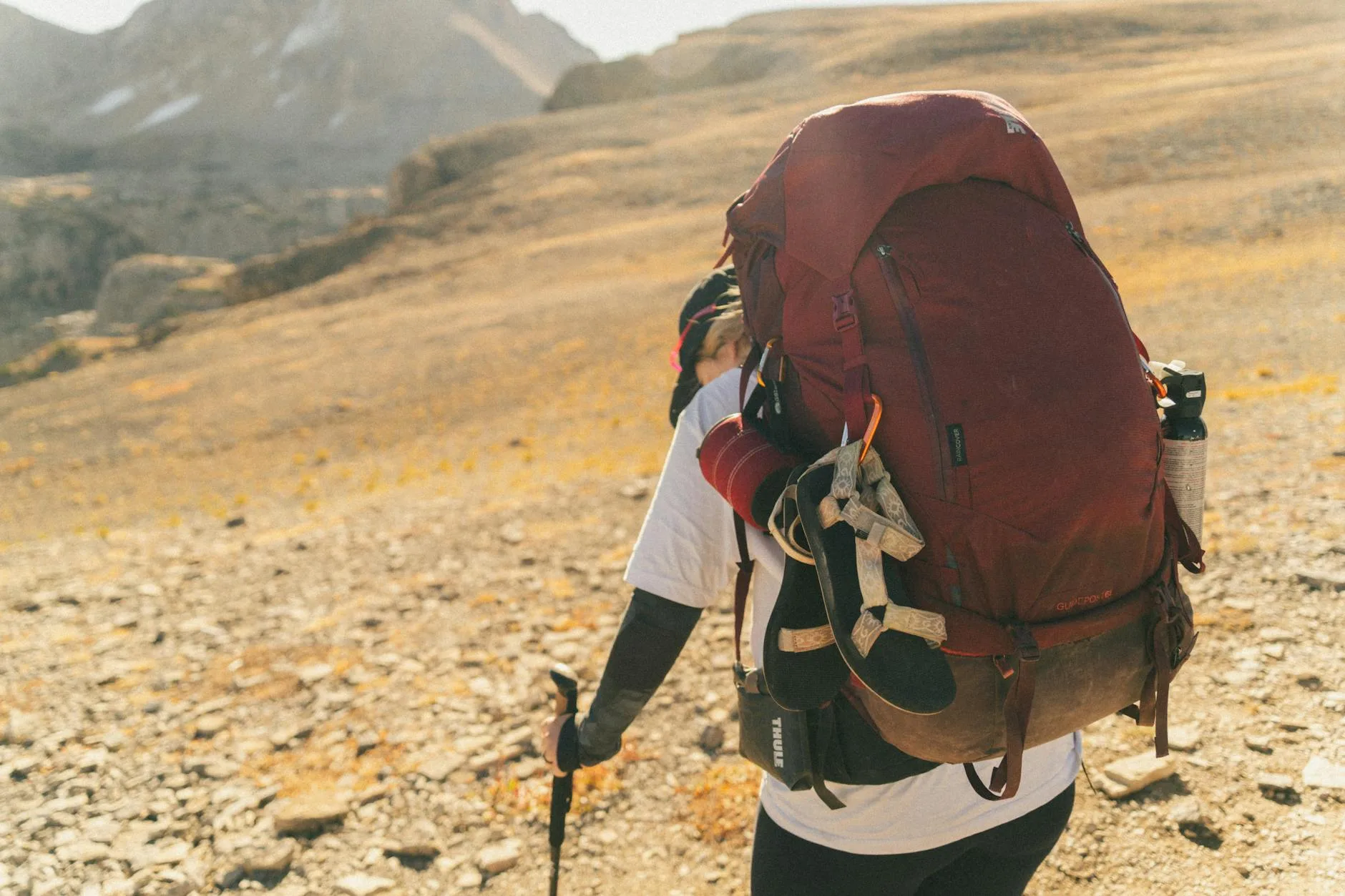
Fitting for Different Body Shapes
Women’s-Specific Fit
Women’s rucksacks have shorter back panels, narrower shoulder straps shaped to avoid the chest area, and hip belts angled differently to accommodate a wider pelvis. If you’re a woman, try women’s-specific packs first — the fit difference is real, not just a colour change.
Shorter Torsos
If your back length is under 43cm, standard small packs may still be too long. Look for brands with extra-small sizes or highly adjustable back systems. Osprey, Deuter, and Gregory all offer extended size ranges. A pack that’s too long is worse than one that’s slightly too small.
Broader Builds
If you carry weight around your middle, standard hip belts may not wrap far enough around. Some brands offer extended hip belts or allow you to swap the hip belt for a larger size. Osprey offers this on several models — you can buy the hip belt separately in your size.
Narrow Shoulders
If shoulder straps slip outward despite the sternum strap, the pack may be too wide for your frame. Women’s packs often have closer-set shoulder straps that suit narrower frames regardless of gender. You may also want to read Best Travel Backpacks 2026 UK: Carry-On Approved.
When the Pack Doesn’t Fit
Signs It’s the Wrong Size
- Load lifters point downward instead of upward at 45° — the pack is too short
- Hip belt sits above or below the iliac crest with all adjustments made — wrong back length
- Shoulder straps have large gaps at the top even when tightened — pack is too long
- You can’t get the hip belt tight enough — your waist size exceeds the belt range
The Adjustable Back Advantage
Many mid-to-premium rucksacks have adjustable back systems that cover a range (for example, 43-53cm). These let you dial in the exact back length rather than choosing between fixed S/M/L sizes. The adjustment usually involves a Velcro panel or ladder system where the shoulder harness attaches to the pack body.
When to Return the Pack
If the pack causes persistent pain in a specific area after proper fitting and adjustment, it doesn’t fit your body shape. No amount of strap tweaking fixes a fundamental mismatch between pack geometry and body geometry. Return it and try a different brand — each manufacturer shapes packs slightly differently.
Common Fitting Mistakes
Carrying All the Weight on Shoulders
The most common mistake by far. New hikers tighten the shoulder straps and barely fasten the hip belt, putting nearly all the load on their shoulders. Reverse this: hip belt carries the load, shoulders just guide the pack.
Wearing the Hip Belt Too Low
The hip belt should sit on the bony iliac crest, not on the soft tissue of your stomach or the top of your thighs. Too low and it chafes against your legs with every step. Too high and it compresses your stomach.
Ignoring Load Lifters Completely
Surveys of hikers at UK trail heads show that roughly half never adjust their load lifters. Mountain Training, the UK’s walking and climbing qualification body, emphasises load lifter adjustment as a core skill in their hillwalking courses. These straps exist for a reason — they’re the difference between a pack that feels planted against your back and one that sways and pulls.
Over-Packing the Top
Heavy items packed at the top of the rucksack raise the centre of gravity and make the pack top-heavy. Heavy items should go in the centre of the pack, close to your back. Light, bulky items (sleeping bag, spare clothing) go at the bottom.
Never Readjusting
The fit that works at the start of the day shifts as you walk, sweat, and fatigue. Check and adjust straps every couple of hours. A 30-second tweak prevents hours of discomfort.
Frequently Asked Questions
How do I know if my rucksack is too big or too small?
Too big: the shoulder straps attach above your shoulders (visible gap at the top), load lifters point downward, and the hip belt sits below your hip bones even at maximum tightness. Too small: the shoulder straps dig into your armpits, the pack body ends well above your waist, and you can feel the top of the pack pushing against the back of your neck.
Should I buy a rucksack online or in-store?
In-store for your first serious rucksack. You need to try it on with weight in it, walk around, and feel how it sits on your body. Sizing charts are a rough guide — actual fit depends on your body shape, not just your back length measurement. Once you know your size in a specific brand, subsequent purchases online are fine.
How much weight should the hip belt carry?
About 70-80% of the total pack weight. If you’re carrying 15kg, roughly 10-12kg should transfer through the hip belt to your hips and legs. The remaining 3-5kg sits on your shoulders and upper back via the shoulder straps. If your shoulders feel like they’re doing most of the work, tighten the hip belt.
What are load lifter straps and why do they matter?
Load lifter straps connect the top of your shoulder straps to the top of the pack body. They pull the upper portion of the pack forward against your back, preventing it from leaning backward and pulling on your shoulders and neck. They should sit at roughly 45 degrees when properly adjusted. Most hikers under-use them — a 30-second adjustment makes a major difference to comfort and stability.
Can I adjust a rucksack fit for different trips?
Yes, and you should. A weekend trip with 8kg requires different strap tension than a week-long trip with 18kg. Lighter loads need less hip belt tension and more shoulder strap involvement. Heavier loads need maximum hip belt transfer. Re-fit your rucksack each time the load changes noticeably.
How big should a hiking rucksack be? For day walks, 20-30 litres is enough. Overnight trips usually need 40-60 litres depending on tent, food and sleeping kit.
How should a rucksack fit? Most weight should sit on your hips, not your shoulders. Adjust the back length, hip belt and load lifters before judging comfort.
Is lighter always better? Not always. Ultralight kit saves energy, but very light packs can be less supportive. Match the pack to the load you actually carry.
Frequently Asked Questions
How big should a hiking rucksack be? For day walks, 20-30 litres is enough. Overnight trips usually need 40-60 litres depending on tent, food and sleeping kit.
How should a rucksack fit? Most weight should sit on your hips, not your shoulders. Adjust the back length, hip belt and load lifters before judging comfort.
Is lighter always better? Not always. Ultralight kit saves energy, but very light packs can be less supportive. Match the pack to the load you actually carry.
What should I check first with Rucksack Fitting Guide: Back Length, Hip Belt & Load Lifters? Start with the real use case, then check size, compatibility, running costs and maintenance. A product that looks good on paper can still be the wrong fit if it does not suit the room, routine or budget.
How do I avoid wasting money on Rucksack Fitting Guide: Back Length, Hip Belt & Load Lifters? Avoid buying on one headline feature alone. Compare the practical details, read the warranty or returns terms, and choose the option that solves your main problem rather than the one with the longest specification list.